
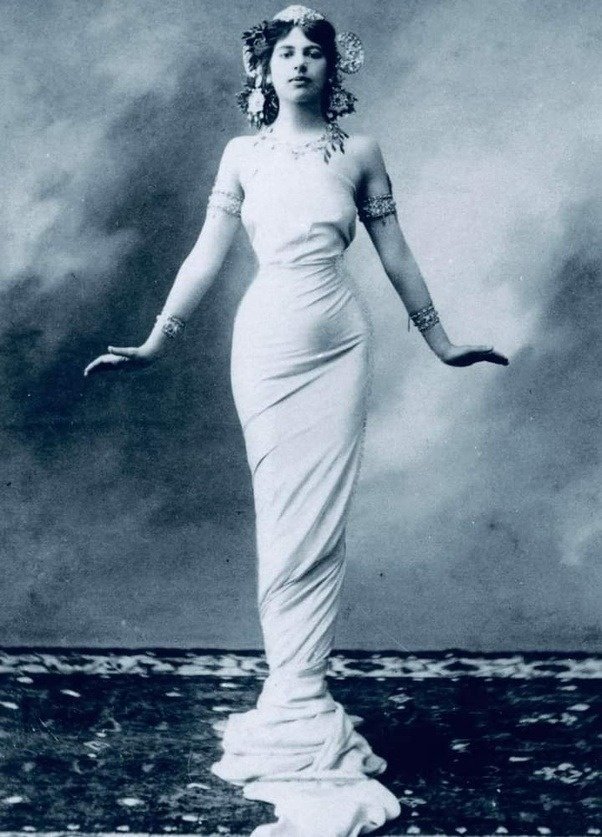
Mata Hari was born Margaretha Geertruida Zelle on August 7, 1876, in Leeuwarden, the Netherlands. She grew up in a comfortable middle-class family, but her life changed early when her parents divorced and her father went bankrupt. After her mother’s death, Margaretha was sent to live with relatives and later trained as a kindergarten teacher, though her education ended after a scandal.
Seeking escape and adventure, she answered a newspaper advertisement and married Rudolph MacLeod, a much older Dutch army officer. The couple moved to the Dutch East Indies (modern Indonesia). Their marriage was unhappy and violent. One of their children died under mysterious circumstances, and after returning to Europe, the marriage ended in divorce, leaving Margaretha poor and alone.
Rise to Fame
In Paris, Margaretha reinvented herself. She created a new identity and took the name “Mata Hari,” which means “Eye of the Day” (the sun) in Malay. She claimed to be an exotic Eastern princess and became famous as an exotic dancer, performing sensual dances inspired by Asian themes.
She quickly became a celebrity in European high society and had many lovers, including wealthy men, diplomats, and military officers from several countries. Her beauty, charm, and independence made her famous—and also suspicious.
World War I and Espionage Accusations
When World War I began in 1914, Europe was filled with spies. Because Mata Hari was Dutch (and the Netherlands was neutral), she could travel across borders more easily than most people.
French intelligence accused her of being a German spy, claiming she passed military secrets to Germany under the code name H-21. Mata Hari admitted she accepted money from a German diplomat but insisted it was payment for personal favors, not espionage. She denied ever betraying France.
Some historians believe she was used as a scapegoat—blamed to boost French morale at a time when the war was going badly. There was little solid evidence against her, and much of the case was based on assumptions, rumors, and secret documents she was not allowed to see.
Trial and Execution
Mata Hari was arrested in February 1917 and put on trial by a French military court. The trial was closed to the public, and her lawyer had very limited ability to defend her.
Despite weak evidence, she was found guilty of espionage and sentenced to death.
On the morning of October 15, 1917, Mata Hari was awakened in her prison cell. Calm and composed, she dressed elegantly in black stockings, high heels, and a fur-lined velvet cape.
At the execution site near Paris, she refused a blindfold and stared directly at the firing squad. According to witnesses, she showed no fear. Twelve soldiers fired their rifles, killing her instantly. She was 41 years old.
No family claimed her body. It was sent to a medical school, and her head was later preserved in a museum, where it eventually disappeared.

0 Comments