
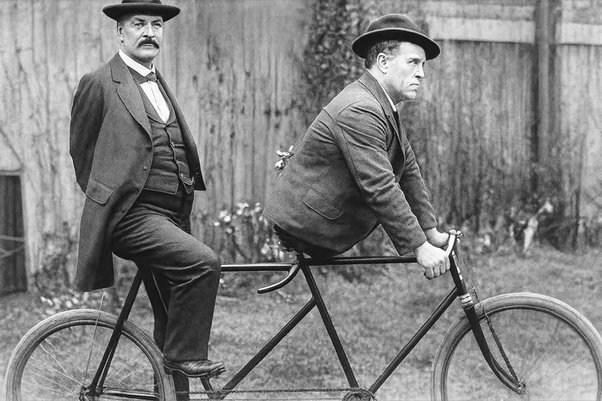
There is a widely shared and inspiring story about the creation of the first two-seater bicycle (often called a tandem bicycle). According to this story, it was created in the late 19th century by two English acrobats: Charles Tripp and Eli Bowen.
Charles Tripp was born without arms, and Eli Bowen was born without legs. Despite their disabilities, both men refused to accept a life of dependence or limitation. They became professional acrobats and performers, astonishing audiences with their strength, balance, and determination.
Daily life, however, was not easy. Transportation was a major challenge. Riding a regular bicycle alone was nearly impossible for either of them. Instead of giving up, they combined their abilities. Tripp had strong legs and balance, while Bowen had a powerful upper body and excellent control.
Together, they designed and built a two-seater bicycle that allowed them to ride as a team. One provided the leg power, the other provided control and stability. What the world saw as a disability, they turned into a solution.
When people asked them what inspired this invention, their answer was simple:
“Impossibility. We had no excuses, no other choice. We had to live, we had to work — so we made it.”
Their story became a symbol of resilience, cooperation, and human creativity. It reminds us that “impossible” is often just a word used when people stop trying. When circumstances force us forward, innovation and courage often appear.
Important note:
While Charles Tripp and Eli Bowen were real historical performers with remarkable lives, historians debate whether they truly invented the first tandem bicycle. Over time, their story has become more of a motivational legend than a fully verified historical fact. Still, the message it carries remains powerful and meaningful.

0 Comments