
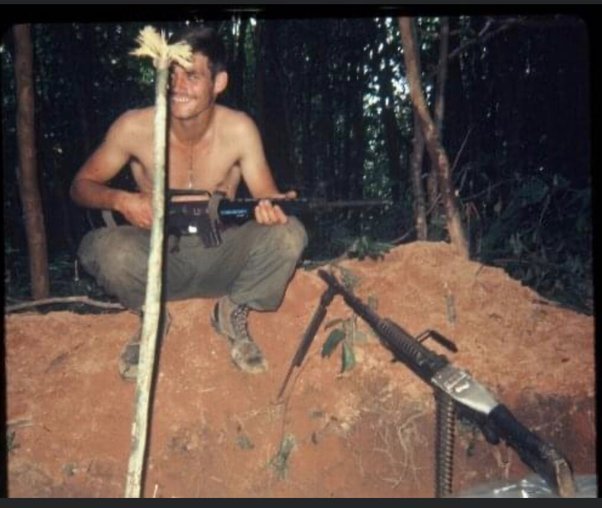
This photograph was taken in 1969, when I was 19 years old. I was sitting near a foxhole close to a North Vietnamese Army (NVA) supply trail. Our unit stayed in that area for several days, setting up ambushes and watching for enemy movement. On one occasion, we managed to catch an NVA group completely by surprise. They dropped their equipment and ran. When we searched the area afterward, we found blood trails, and I picked up a few items they left behind—a well-made hammock, an NVA belt, and a pair of sandals made from old tires.
During basic training, I learned to use the M14 rifle. Later, in Advanced Infantry Training, I trained with the M16. The M14 is a very heavy weapon, and its ammunition is heavy as well. While it fires a larger and more powerful round, I don’t believe that makes it a better combat weapon for infantry use. From my experience, if someone is hit anywhere on their body by an M16 round, they are out of the fight and could easily be fatally wounded. In my opinion, the M14 is overkill for human targets and simply not worth carrying because of its weight.
In Vietnam, soldiers in my unit were allowed to choose whether they wanted to carry the M14 or the M16. Not a single person chose the M14. Everyone preferred the M16 because it weighed about half as much, and the ammunition was far lighter. Weight mattered a great deal because we carried our weapons every single day, everywhere we went. If someone tried carrying an M14 along with about 25 pounds of ammunition—roughly 400 rounds—for even a day or two, they would quickly switch to the M16.
The M16 I carried was stamped “GM Hydramatic Division.” It never gave me any trouble. I made sure it was properly lubricated every day and always cleaned it after firing. Because of that care, it functioned perfectly. For jungle warfare in Vietnam, it was the right weapon—light, reliable, and effective.

0 Comments