
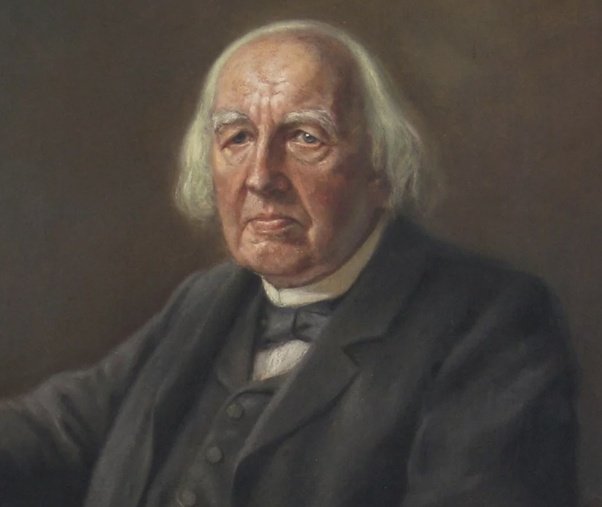
Karl Weierstrass (1815–1897) is remembered today as one of the founders of modern mathematical analysis, but his early life did not look promising at all.
As a young man, Weierstrass went to university to study law, mostly to satisfy his father. Instead of attending classes seriously, he spent much of his time drinking beer, socializing, and practicing fencing. As a result, he failed to complete his studies and left the university without earning a degree. For many years, he seemed like a talented but unsuccessful student with no clear future.
After this, Weierstrass trained as a schoolteacher and began working at small secondary schools in Prussia. For almost 15 years, he lived what could be called a “double life.” During the day, he worked as an ordinary high school teacher. His workload was heavy and exhausting. He taught not only mathematics and physics, but also history, geography, German language, gymnastics, and even handwriting. Teaching math was only a small part of his job.
However, at night, Weierstrass became a completely different person. After long school days, he would sit alone in his room, working intensely on mathematical problems. With no university position, no colleagues, and little recognition, he developed deep ideas about functions, limits, and rigor in mathematics. During this time, he laid the foundations for the precise definition of limits using epsilons and deltas—the same definition that students still learn today and often find difficult but powerful.
A famous story from this period shows how deeply absorbed he was in his work.
One morning, the headmaster of the school in Braunsberg heard loud noise coming from the classroom where Weierstrass was supposed to be teaching. Thinking something was wrong, he rushed there—but the classroom was empty. The students were waiting, but their teacher had not arrived.
Worried, the headmaster went to Weierstrass’s living quarters. When he entered the room, he found Weierstrass still sitting at his desk. The shutters were closed, and a lamp was burning. Weierstrass had been working all night and had not realized that morning had already come.
When the headmaster told him that it was daytime and his class was waiting, Weierstrass calmly replied that he was on the edge of a major mathematical discovery—one that would be important for the scientific world—and that he simply could not stop his work at that moment.
Years later, Weierstrass’s research was finally recognized. He became a professor at the University of Berlin and one of the most influential mathematicians of the 19th century. His work changed how mathematics was written, taught, and understood.
This story reminds us that great discoveries sometimes come from quiet determination, patience, and years of unseen effort.

0 Comments