
In the early 1900s, Greenland became the center of an international disagreement. The United States believed that a channel called Peary Channel (or Peary Sound) cut Greenland into two separate landmasses. If that were true, the U.S. could claim part of Greenland. Denmark, however, argued that Greenland was one single island, and proving this was very important for Danish sovereignty.
To settle the issue, Denmark sent an expedition in 1906 led by Ludvig Mylius-Erichsen. That expedition disappeared, but before they vanished, they had likely discovered proof that Peary Channel did not exist. Unfortunately, their map and diary, which contained the evidence, were lost.
So in 1909, Danish explorer Ejnar Mikkelsen was sent to Greenland to recover those missing documents. He led the Alabama Expedition. The mission was extremely difficult from the start—ice blocked ships, weather delayed travel, and supplies ran low.
Eventually, Mikkelsen and a young crew member named Iver Iversen set out on a long sled journey across northeastern Greenland. They successfully found the lost map and diary, confirming that Greenland was indeed one continuous island, proving Denmark’s claim correct.
However, when they returned to their base, they discovered something devastating:
Their ship was gone.
The rest of the crew had left, believing Mikkelsen and Iversen were dead.
Stranded with almost no supplies, the two men took shelter in a small, crude wooden cabin. They survived there for two and a half years in brutal Arctic conditions. Food was so scarce that they were eventually forced to eat their sled dogs. They suffered from starvation, extreme cold, and mental strain. At times, they hallucinated animals and people, a common effect of prolonged hunger and isolation. They also had to defend themselves from polar bears.
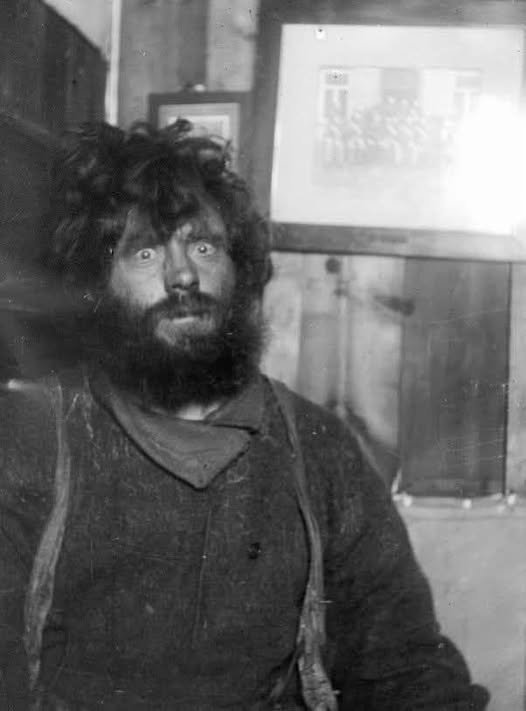
Inside the cabin was a single photograph taken from a magazine or newspaper. It showed 53 young women from a home economics school. With nothing else to do, Mikkelsen and Iversen began talking about the people in the photo—imagining their personalities, inventing stories about their lives, and even arguing about them. The photo became a psychological anchor that helped them stay sane during isolation.
In 1912, a Norwegian sealing ship finally reached the area and rescued them. When Mikkelsen was photographed after his rescue, the picture of the students could be seen hanging on the wall behind him—silent proof of how important that image had become to their survival.
Although the mission nearly killed him, Mikkelsen succeeded. The recovered documents proved Denmark’s claim, and Greenland was officially recognized as one island, remaining under Danish control.
This story is remembered today as one of the most powerful examples of human endurance, isolation, and survival in polar exploration history.

0 Comments