
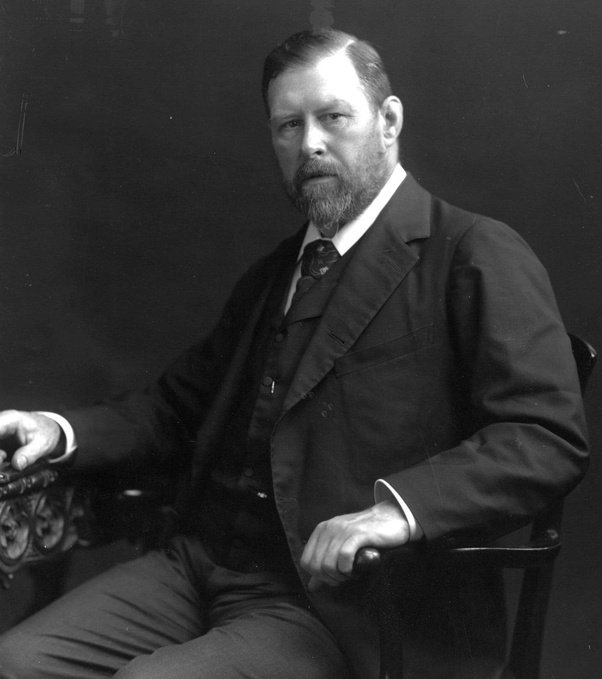
Abraham “Bram” Stoker, the author of Dracula, died on April 20, 1912. His death was quiet and largely unnoticed. According to many accounts, he suffered from complications related to syphilis, a disease that was poorly understood and difficult to treat at the time. Stoker passed away in a small boarding house in London, and by then he was poor, weak, and no longer famous.
What made his death even more obscure was the timing. Just a few days earlier, the Titanic had sunk, shocking the world and completely dominating the news. Because of this massive tragedy, Stoker’s death received very little attention. Newspapers barely mentioned it, and few people realized that the man who had written one of the most important horror novels in history had just died.
During his lifetime, Bram Stoker was not primarily known as a writer. Writing did not bring him much money or fame. In fact, Dracula, published in 1897, was not an immediate success. Stoker earned most of his living through his work in the theater. For 27 years, he worked closely with the famous English actor Sir Henry Irving. Stoker was Irving’s personal assistant, secretary, and business manager, and he also helped manage the Lyceum Theatre in London. His life was demanding, and much of his energy went into supporting Irving’s career rather than promoting his own writing.
After Bram Stoker’s death, it was his wife, Florence Balcombe Stoker, who played the most important role in preserving his legacy. Florence was a strong and determined woman. Earlier in her life, she had even been romantically involved with Oscar Wilde before marrying Stoker.
In 1922, Florence learned about a German silent film called Nosferatu. The movie was clearly based on Dracula but had been made without permission and without crediting Bram Stoker. Furious and protective of her husband’s work, Florence decided to take legal action. She sued the filmmakers for copyright infringement.
Florence won the lawsuit. The court ruled in her favor, awarded damages, and ordered that all copies of the film be destroyed. Although some prints survived, her legal victory was significant. It helped establish Dracula as a protected literary work and brought renewed attention to Bram Stoker’s novel. The money she received also helped support her later in life.
Thanks largely to Florence’s efforts, Dracula slowly gained recognition and popularity. Over time, it became one of the most famous and influential novels ever written, inspiring countless books, films, and adaptations. Ironically, Bram Stoker achieved the fame and success he never enjoyed in life only after his death.
Today, Bram Stoker is remembered as a giant of Gothic literature, and Dracula is considered a timeless classic—proof that a legacy can grow long after its creator is gone.

0 Comments