
In the absence of civil society (i.e. a public space between the state and the ordinary household, in which people can independently debate and take political action) in the USSR, for most of the 20th century, the criminal world remained an escape hatch for many of those who didn’t like the Communist project. Between the wars, thieves were considered “socially close” to proletarians: they didn’t possess private property like the bourgeois class.
In the Gulag, criminals had a lot of privileges compared to political convicts. Which is why in the darkest days of the Great Purges a lot of generally law-abiding citizens went for petty theft in the hope to go below the radar from the threat of being arrested by the secret police NKVD.
After the death of Stalin millions of inmates were released from the Gulag and from exile settlements deep in the provinces. They brought into the mainstream society a subversive cynicism of the underworld that had known no party cells or Marxist study circles. The cool gangsta jargon and mannerisms swiftly spread among younger generations that a few decades later brought us Vladimir Putin.
According to Putin’s own accounts from his childhood, the criminal subculture was prominent across Leningrad (St Petersburg) in the 1950s and 1960s. Hence, his affinity to martial arts, the locker room humor, his indirect yet colorful style of threats, his habit to scowl when speaking if he is irritated. In the moments of silent triumphs and self-congratulation, he sometimes drops his usually straight posture and assumes a blatnói (“gangsta”) slouch in combination with a low-key vindictive grin on his face—the mark of a successful, self-assured “thief-in-law” who is used to score good points one after another, but has been around long enough not to flaunt his fart (“criminal luck and skill”) too much.
None of his predecessors in the Kremlin, including Khrushchev and Brezhnev, the two men of proletarian provenance, have displayed the same flair for criminal mannerisms. This must have played a considerable part in Putin’s public appeal. In the 1990s, the old Soviet elite became saturated with newly-rich criminals who totally changed the face of our culture. They didn’t like the stiff, conservative old-timers on top shaped by the progressivist, “cultured” Soviet education. Putin, with his hands-on pragmatism, respect for money and the apparent street cred of a seasoned secret operative was a breath of fresh air for the new generation.
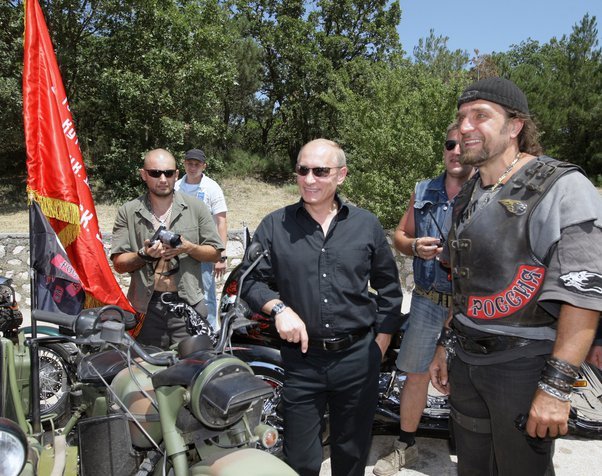
Below: President Putin enjoying himself in the company of patriotic one-percenters.

0 Comments