
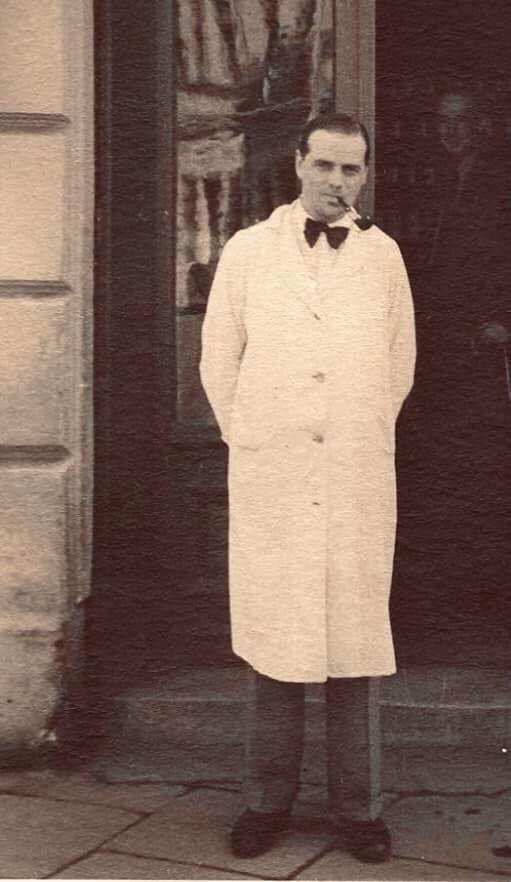
Tadeusz Pankiewicz was a Polish pharmacist living in Kraków, Poland, when World War II began in 1939. His family owned a small pharmacy called “Under the Eagle” (Apteka Pod Orłem), located in a neighborhood where Jewish and non-Jewish people had lived together for many years.
In 1941, after occupying Poland, the Nazis created the Kraków Jewish Ghetto. Thousands of Jewish families were forced to leave their homes and were crowded into this sealed-off area. Pankiewicz’s pharmacy happened to be located inside the new ghetto.
The Nazis ordered all non-Jewish residents and businesses to leave the area. However, Pankiewicz refused to abandon his pharmacy. After persistent requests, he managed to convince the German authorities to let him stay, arguing that the ghetto needed a pharmacy. This decision made him the only non-Jewish permanent resident of the Kraków Ghetto.
Inside the ghetto, about 15,000 Jews lived under terrible conditions. Food, medicine, and basic supplies were extremely limited. As a pharmacist and a compassionate person, Pankiewicz chose to help, even though it put his own life in danger.
He and his female employees secretly provided medicine, medical advice, and emotional support to ghetto residents. He supplied sedatives and painkillers, often without charge. He gave out hair dye and false documents to help people disguise themselves and attempt escape. When he learned about upcoming Nazi raids, he quietly warned people so they could hide or prepare.
His pharmacy became more than a place for medicine. It became a safe meeting place, a hiding spot, and a center of information. People came there to talk, to mourn, and to cling to hope. During Nazi searches, Pankiewicz sometimes hid people in the back rooms of the shop.
In March 1943, the Nazis destroyed the Kraków Ghetto. Most of its Jewish residents were deported to Auschwitz and Bełżec concentration camps. The city was declared “Judenfrei”—“free of Jews.”
But even after the ghetto’s destruction, Pankiewicz protected an important secret. In the basement of his pharmacy, he had hidden Torah scrolls and other sacred Jewish religious objects. He preserved them carefully, knowing they represented the spiritual life of a community that had been almost completely destroyed. After the war, these items were returned to the Jewish community.
After World War II, Tadeusz Pankiewicz wrote a memoir called “The Kraków Ghetto Pharmacy”, in which he documented what he witnessed and the courage of the people he tried to help.
In recognition of his bravery, he was honored by Yad Vashem as “Righteous Among the Nations,” a title given to non-Jews who risked their lives to save Jews during the Holocaust.
Today, the Under the Eagle Pharmacy still stands. It has been turned into a museum, reminding visitors of how one ordinary man chose humanity over fear—and proved that even in the darkest times, individual courage can make a difference.

0 Comments