
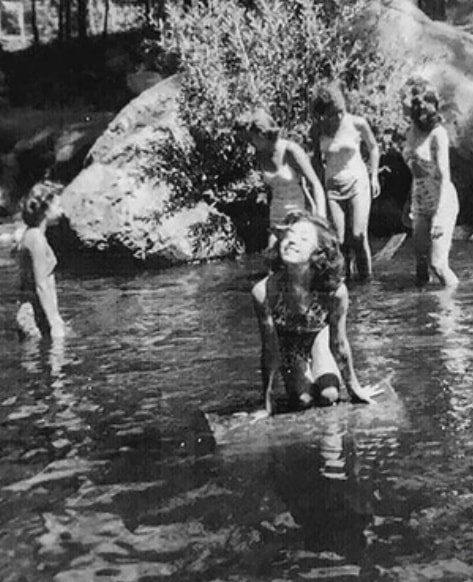
In July 1945, a group of thirteen-year-old girls went camping in America. They were swimming in a river in Ruidoso, New Mexico. The girl in front of the photo is named Barbara Kent. What the girls didn’t know was that nearby, the Manhattan Project was testing a nuclear bomb.
Barbara later said what happened that day:
“We were all shocked… then suddenly, a big cloud appeared above us, with bright lights in the sky,” she said. “It even hurt our eyes to look up. The sky looked strange, like the sun was shining very bright.” A few hours later, white flakes started falling from the sky. The girls thought it was snow, so they played in the river wearing their swimsuits. “We grabbed the white flakes and put them on our faces,” Barbara said. “But the flakes were hot, not cold like snow. We thought maybe it was hot because it was summer. We were only 13 years old.”
The white flakes were radioactive dust from the Manhattan Project’s Trinity test—the world’s first atomic bomb explosion. It happened early in the morning on a steel tower about 40 miles away, at a place called the Alamogordo Bombing and Gunnery Range. The area was supposed to be empty, but thousands of people lived within 40 miles, some only 12 miles away. No one was warned about the test, and no one was told to leave before or after, even though the dangerous dust kept falling for days.
Barbara Kent and all the girls who were with her got cancer. Every one of the girls in the photo died before they turned thirty. Barbara lived longer but also had cancer many times. People often forget that the atomic bombs caused harm not just in Japan, but also to those who lived near where the bombs were first made and tested.

0 Comments