
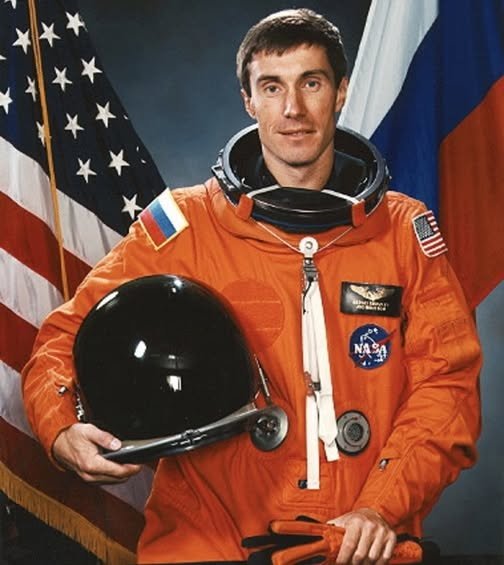
Lost in Space
In 1991, cosmonaut Sergei Krikalev left Earth for the Mir space station on a mission that was supposed to last 150 days. But soon after, his Soviet homeland disappeared completely, leaving Krikalev floating above Earth with no country to return to and at risk of serious health problems from staying in space too long.
The plan for the five-month mission was for Krikalev and his team to do system repairs, carry out scientific experiments, and perform spacewalks if needed. They arrived on May 18, 1991, and immediately faced challenges.
After a problem with the targeting system, Krikalev had to dock the spacecraft manually. Any small mistake could have been deadly for him, cosmonaut Alexander Volkov, scientist Anatoly Artebarsky, and British astronaut Helen Sherman. Despite the danger, the docking was successful, a sign of the tough journey ahead.
At first, Krikalev loved life on Mir. He did his work with energy and enjoyed looking out at the Earth from the viewing window.
“Every spare moment we tried to look at it,” he said.
His day started at 8 a.m. After breakfast, he spent several hours suited up for his work. Lunch was at 1 p.m., followed by three more hours of tasks and then a daily workout.
While life on Mir was organized, things on Earth were falling apart. The Soviet Union was collapsing, and the chaos below directly affected Krikalev, 400 kilometers above.
Soviet President Mikhail Gorbachev announced that when Krikalev’s mission ended, a Kazakh cosmonaut would replace him. But no Kazakh cosmonaut existed yet, which meant Krikalev had to stay in space longer than planned.
Krikalev stayed focused and did his work. Four months in, Artebarsky and Sherman returned to Earth. Then Krikalev learned the crumbling Soviet Union had no money to send replacements, so he and Volkov would remain in space for an unknown period.
The long stay changed everything for Krikalev. He lost his excitement for daily life in space. His small cabin felt like a “death trap held together by wire, duct tape, and WD-40.” He felt extreme stress, worried about being in space longer than his body could handle, and missed his nine-month-old daughter.
On Christmas Day 1991, the Soviet Union officially ended. Not only would there be no one to relieve Krikalev, but he also had no country. His hometown, Leningrad, was renamed St. Petersburg, and the old Soviet leaders were gone. The empire split into 15 nations.
Krikalev
The
Krikalev’s wife Elena worked at mission control and spoke to him weekly.
“I tried never to talk about unpleasant things because it must have been hard for him,” she said.
Finally, in early March 1992, Krikalev and Volkov learned that a replacement, German astronaut Klaus-Dietrich Flade, was coming. They prepared to return to Earth.
They landed in Kazakhstan on March 25. The man called “The Last Soviet” was finally home, though the world he returned to was very different.
Nearly a year in space had taken a toll. He was “as pale as flour and sweaty like a big lump of wet dough” and needed four men to help him stand. Despite the long mission, Krikalev had no major lasting health problems.
“Blood”

0 Comments