
In early 1945, as World War II was nearing its end, Japan launched a sudden coup (the Meigo Sakusen or “Operation Bright Moon”) across French Indochina. The Japanese military sought to remove all remaining French colonial authority, fearing that French officials might support an Allied invasion.
During this operation, many French soldiers, administrators, engineers, and civilians were arrested. Some were interned, but others were executed.
Among the victims were several French engineers and civilians who were killed by the Japanese army in March 1945. Their remains were later transported to France, and their graves now lie in the military square of the Poissy cemetery, near Paris. These graves stand as a reminder of the violence surrounding the collapse of French power in Indochina during Japan’s final months of the war.
2. The Thakhek Massacre (March 21, 1946)
After Japan’s defeat in August 1945, French forces attempted to re-establish colonial control over Indochina, including Laos and Vietnam. But during this period, nationalist movements were rapidly gaining strength, including the Viet Minh in Vietnam and their Laotian allies, the Pathet Lao.
The recapture of Thakhek
Thakhek, a town in central Laos near the Mekong River, was seized by Pathet Lao forces backed by the Viet Minh. In March 1946, French troops launched an operation to retake the town. After heavy fighting, they succeeded.
Reported mass killing of civilians
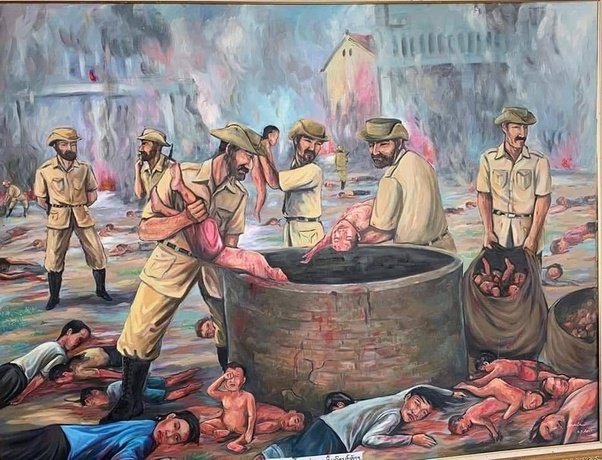
According to several Laotian sources and later testimonies, what followed was a large-scale massacre carried out by French colonial troops. These reports claim:
- Between 1,500 and 3,000 civilians—mostly Vietnamese living in Thakhek—were killed.
- Many victims were said to be unarmed townspeople accused of supporting the communists.
- Some Laotian accounts state that bodies were thrown into a well, which became a symbol of the massacre.
- The killings were reportedly carried out as retribution for resistance activity and the deaths of French soldiers during the fighting.
Because documentation from this period is limited and colonial archives were controlled by the French government, the exact number of victims and the full details remain debated among historians. However, the event is remembered in Laos as one of the most tragic episodes of the early First Indochina War.
Historical significance
These two events—one carried out by the Japanese army in 1945, and the other reportedly by the French army in 1946—reflect the chaotic power struggle in Indochina at the end of World War II:
- The Japanese coup of 1945 destroyed the remaining French colonial administration.
- The French return in 1946 led to harsh reprisals and helped fuel anti-colonial resentment.
Together, they form part of the complex and violent history that eventually culminated in the First Indochina War (1946–1954).

0 Comments