
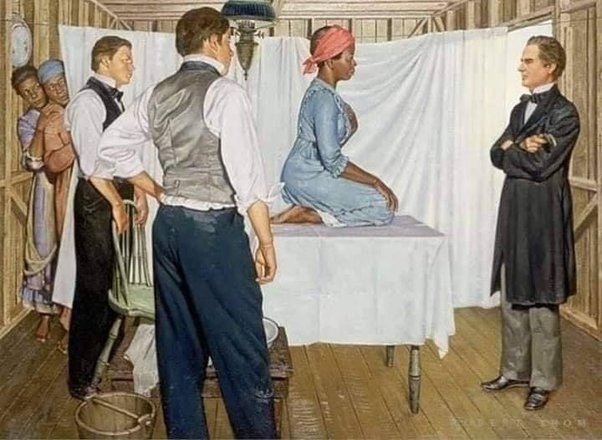
Few doctors have been as praised and loathed as James Marion Sims.
Credited as the “father of modern gynecology,” Sims developed pioneering surgical tools and techniques related to women’s reproductive health. He invented the vaginal speculum, an instrument used for dilation and examination. He also pioneered a surgical technique for repairing vesicovaginal fistulas.
But because Sims’s research was conducted on enslaved black women without anesthesia, medical ethicists, historians, and others say his use of enslaved black bodies as medical test subjects is part of a long and ethically questionable history that includes the Tuskegee syphilis experiment and Henrietta Lacks.
Critics say Sims was more concerned with experiments than with providing therapeutic care and that he caused untold suffering by operating under the racist idea that black people did not feel pain.
James Marion Sims “repaired” plantation women so that they could reproduce and produce new slaves, otherwise the slaves would be useless to their masters.
Sims performed numerous operations on young black women, all of whom received no anesthesia and were in excruciating pain throughout the procedure.
This choice was based on his misguided belief that black people did not feel pain like white people. It is a notion that persists today, according to a study conducted at the University of Virginia and published in the Proceedings of April 4, 2016 of the National Academy of Sciences, black Americans are systematically undertreated for pain compared to white Americans, based on absurdities and prejudices such as the fact that there are biological differences between blacks and whites (for example, “black skin is thicker than white skin”).
The Hippocratic Oath between the lines reads:
«Aware of the importance and solemnity of the act that I perform and the commitment that I assume, I swear:
- to practice medicine with autonomy of judgment and responsibility of behavior, opposing any undue conditioning that limits the freedom and independence of the profession;
- to pursue the defense of life, the protection of physical and mental health, the treatment of pain and the relief of suffering, respecting the dignity and freedom of the person, which with constant scientific, cultural and social commitment I will inspire every one of my professional acts;
- to treat every patient with care and commitment, without any discrimination, promoting the elimination of every form of inequality in health care;.
But unfortunately, even today, in some cases, this is not the case…

0 Comments