
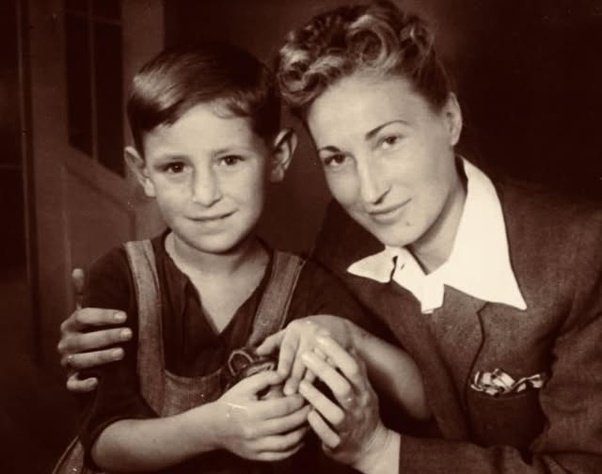
In 1941, during the darkest days of World War II, the city of Białystok in German-occupied Poland was turned into a Jewish ghetto by the Nazis. Thousands of Jewish families were imprisoned there under brutal conditions, facing hunger, disease, and constant fear of deportation and death.
Among them was a newborn Jewish baby boy. His mother had already been killed by the Nazis, and his father was involved in the Jewish underground resistance, fighting in any way he could against the occupation. Because of his activities, the father knew his child would not survive long inside the ghetto.
Desperate to save his son, he reached out to a young Polish Catholic woman named Genowefa Majcher. She was unmarried and lived outside the ghetto. When she was asked whether she would take the baby and raise him as her own, she did not hesitate. She simply said:
“Yes. I will take him.”
Genowefa understood exactly what this meant. In Nazi-occupied Poland, helping Jews was punishable by death, not only for the helper but often for their entire family. Still, she chose compassion over fear.
She secretly smuggled the baby out of the ghetto, an act that alone could have cost her life. From that moment on, she became his mother in every way that mattered. To protect him, she gave him a Christian name, Michael, and had him publicly baptized, making his identity appear completely Polish and Catholic. This was an extremely risky step, but it helped shield the child from suspicion.
Genowefa raised Michael with deep love and care. She provided him with food, safety, and affection during years when even survival was uncertain. She never treated him as anything less than her own son. Despite living in constant danger, she never betrayed his secret.
In 1945, after the war ended, the child’s biological father returned, having survived the Holocaust and the resistance. When he saw his son alive, safe, and healthy, he was overwhelmed. He fell to his knees and wept, realizing the magnitude of what Genowefa had done.
Michael returned with his father to rebuild their lives, but the bond with Genowefa never broke. He continued to visit her and remained emotionally close to the woman who had saved him when the world had turned its back.
In 2003, Genowefa Majcher was officially recognized by Yad Vashem in Israel as “Righteous Among the Nations,” an honor given to non-Jews who risked their lives to save Jews during the Holocaust. That same year, she passed away.
Genowefa Majcher did not carry a weapon or fight on a battlefield. Yet her courage, love, and moral strength saved a life. She stands as a powerful reminder that even in times of great evil, one person’s choice to do good can change the course of history.
She was, and remains, a true heroine.

0 Comments