
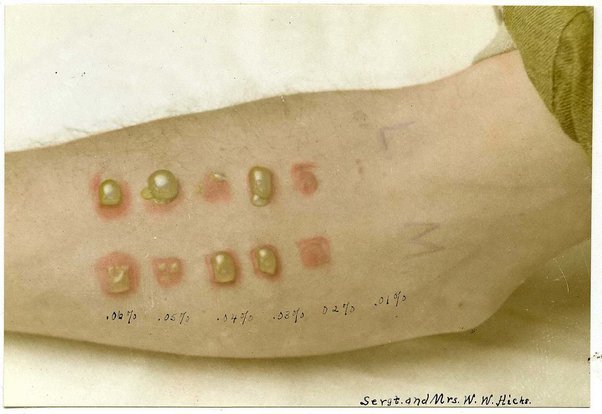
There are weapons of war that have been devised with the sole intent of demoralizing the enemy. One of the worst of these would have to be mustard gas.
** Examples of mustard gas burns. Image from the National Museum of Health and Medicine.
What we call mustard gas, really isn’t a gas at all. It is a fairly high-boiling-point viscous liquid that is dispersed as a fine mist of liquid droplets.
It was banned by the 1925 Geneva protocol following its horrific use in WWI.
** WWI troops being evacuated from the battlefield due to mustard gas burns.
Mustard gas was first used in combat operations by the Germans in WWI with the intent of demoralizing the enemy rather than killing him. To that end, it worked well.
The gas is generally colorless but may have a slightly yellowish or greenish tint to it. The odor smells vaguely of mustard but has also been compared to horseradish or garlic mixed with sulfur.
Victims of a mustard gas attack would suffer a blistering of the skin and an extreme burning of the eyes. They would begin to vomit as they inhaled the gas—painful blisters formed in the mouth, throat, and lungs as well. Mucous membranes were stripped from the bronchial tubes. Fatally injured soldiers could take four or five weeks to die from mustard gas exposure.
Despite bans on the use of this weapon of war, it continues to be deployed. ISIS has used mustard gas to attack its enemies recently during the ongoing civil war in Syria.

0 Comments